Distinguish the pattern of reduced service
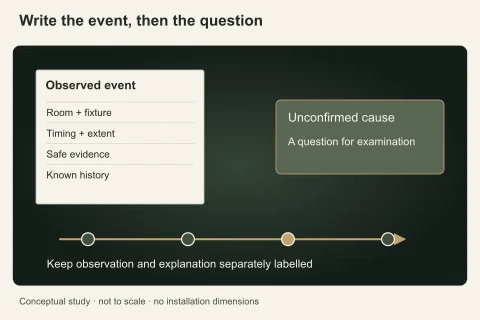
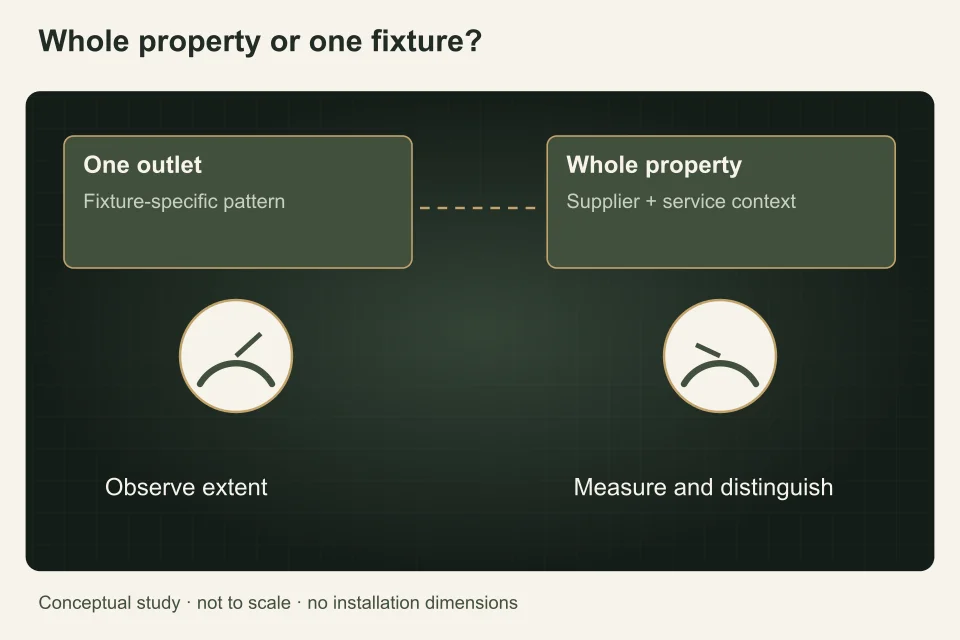
Describe whether the change affects every fixture or one outlet, whether it is constant or intermittent and whether neighbours report a similar event. Record recent road work, utility notices and interior renovation without assuming any one item is the cause. A fixture-specific symptom differs from a whole-property loss of service. Information from the water supplier can help determine whether a broader interruption is being investigated.
Do not adjust unfamiliar pressure equipment or operate street-side valves to test a theory. Ask a qualified professional what measurements are appropriate and what conditions they establish. Household observations can narrow the brief, but they cannot certify pressure performance across an unseen service.
Establish the ownership and permission boundary
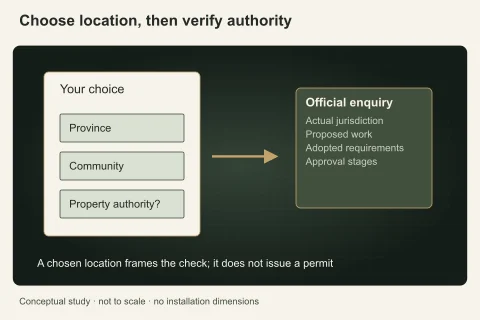
The division between municipal and private responsibility varies with the local utility and property arrangement. Ask the water supplier for the service boundary, available records and any required connection or shutdown process. The curb, property line and location of a valve are clues to investigate, not interchangeable legal answers. A contractor’s quoted excavation route should be checked against the actual authority and property records.
For shared properties, confirm whether the service supplies more than one building or unit. Access, shutdown notice and authorization may require coordination beyond one owner. Record who approves work and who arranges any public-system involvement before buying a private service replacement.
Treat material and water quality as evidence questions
Appearance, building age and a neighbour’s replacement do not establish your buried pipe material. Ask which records or professional observations support the identification. Health Canada’s lead information points readers toward water-supplier knowledge and appropriate testing; clear-looking water does not prove the absence of lead. Use the relevant authority’s current guidance for any water-quality concern.
Do not scratch, cut or dismantle an unknown service to identify it. A material finding should state which segment was examined and what remains uncertain. If replacement is proposed for a quality reason, clarify how the complete service and any remaining interior components will be considered.
Investigate the route and construction constraints
A buried service scope needs more than length. Discuss utility locating, private services, foundation entry, surface finishes, trees and access for equipment. Locates do not automatically reveal every privately installed pipe or cable. Ask who arranges records and further investigation when information is incomplete. A trenchless method still needs suitable access and a feasible path.
Professional design must determine required dimensions, protection and connection details for the jurisdiction. This guide is not a digging plan. Compare whether the proposal includes excavation, temporary water arrangements, testing, reinstatement and any permit or road-use process rather than selecting a method solely from a short promotional description.
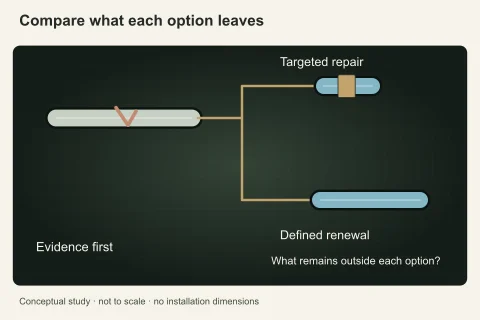
Require a defined post-work record
Ask for the replaced segment, installed material, connection points, tests and relevant authority inspection or closure record. A simple route sketch and photographs before covering can help future work if they are accurately labelled. Request a separate list of any retained old section and the reason it remains. The final invoice should correspond to the approved boundaries, not imply that every water issue has been solved.
After service is restored, record whether the original symptom changed and whether further interior assessment is needed. A new buried line cannot by itself establish the condition of all indoor valves and fixture connections. Keep unresolved distribution or water-quality questions visible in the handover.
Prepare a water-service request
Build a water-service request around the decision you need. Describe the whole-home or fixture-specific pattern, utility notices, known service records and shared ownership. State whether material identification is confirmed or only suspected. Select the province and community yourself, identify the property type and say whether you are the owner, tenant or authorized manager. An approximate location is sufficient for early planning; private access instructions and personal documents belong in a later secure conversation with the person who actually needs them. Distinguish a preferred date from confirmed attendance, and tell the reviewer which facts are still unknown.
PlumbersNearMe.ca is a Canadian reference and human-reviewed request service. It is not a plumbing contractor, ranked directory or emergency dispatcher, and a submitted request does not reserve a provider. A person reviews the information and replies without a promised response time. Ask for the investigated segment, installed route if work proceeds and any remaining ownership or quality uncertainty to be documented. Keep the written agreement, approvals and completion evidence with the property record. Use the request form after any immediate safety need has been addressed; do not wait for this site to respond to an active hazard.
Questions people ask
Does low pressure mean the buried pipe needs replacement?
Not by itself. The pattern, utility conditions and professional measurements matter. Request an investigation that separates the public network, private service and indoor distribution before accepting a single-cause replacement proposal.
Can house age prove a lead service?
Age may justify asking for records, but it is not material confirmation. Contact the water supplier and follow current testing guidance. Record which part of the service was identified and what remains unknown.
Who owns the pipe to the street?
The boundary depends on the utility and property arrangement. Request the local service policy and property records. Do not infer responsibility solely from the property line, curb valve or a contractor’s generic diagram.
Is trenchless work always less disruptive?
It may reduce some surface opening where conditions suit, but access, utility conflicts and connections remain relevant. Ask for the actual route, entry points and restoration scope. A method label cannot guarantee suitability or eliminate approvals.
Sources and further reading
- What about lead? ↗ · Health Canada. Checked 2026-10-02.
- National Plumbing Code of Canada 2025 ↗ · National Research Council Canada. Checked 2026-10-02.
- Home renovations ↗ · Office of Consumer Affairs, Government of Canada. Checked 2026-10-02.
Confirm the current requirements with the responsible authority for the actual address and work. This reference does not replace site assessment or an official decision.