Identify the contracting party and arrangement
Record the legal business name, contact details and the work address used in the agreement. Clarify whether the arrangement is a diagnostic visit, a defined repair or a larger renovation. A platform enquiry, referral or preferred appointment does not necessarily create a work contract with a provider.
Read how and where the agreement is made and whether payment precedes work. Those facts can matter to the applicable consumer rules. Avoid interpreting an informal message as the final complete scope when the parties have not agreed on deliverables, financial terms or authorization.
Use official provincial guidance
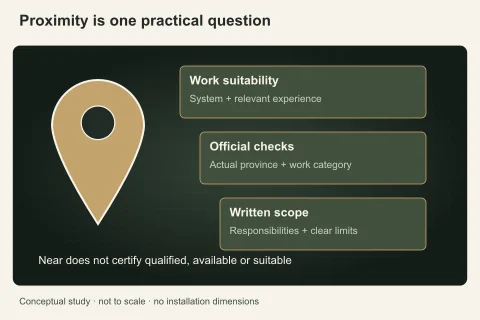
Ontario’s renovation and repair guidance and Alberta’s contractor guidance show why location matters. Their processes and protections are not interchangeable national rules. Find the responsible consumer authority for the contract jurisdiction and read current guidance on the actual arrangement. Seek appropriate advice where the legal effect is uncertain.
This site does not provide a universal cooling-off period, deposit cap or estimate overrun rule. A numerical rule taken from another province can create false confidence. Keep the official link and the contract facts together so any question is assessed against the right framework.
Make the scope and exclusions readable
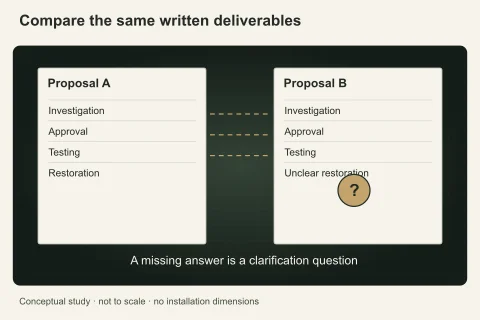
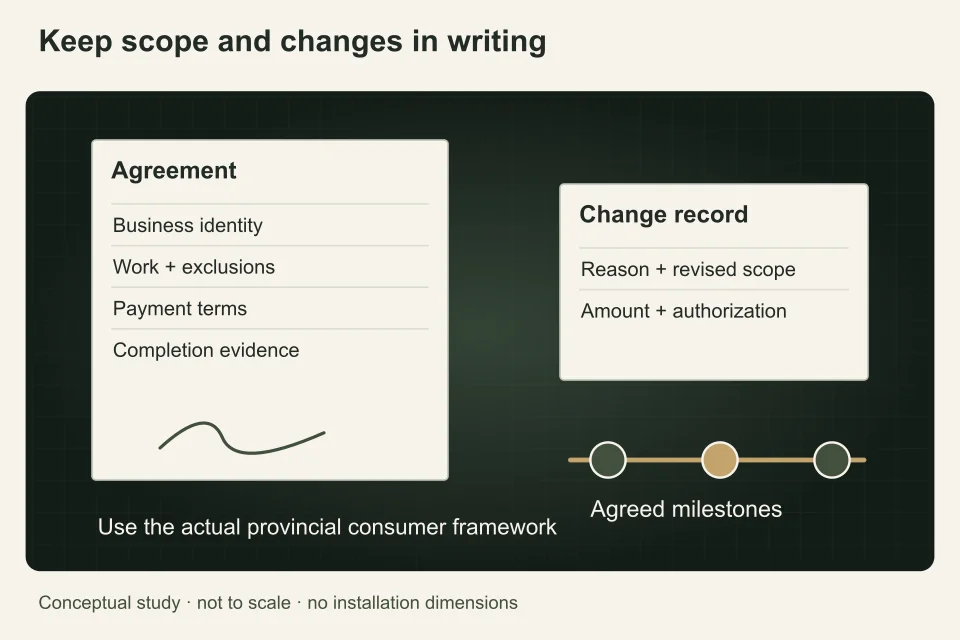
List the investigated or changed system, products, access, approvals, testing and restoration. Identify conditional allowances and owner-supplied items. Ask what happens if concealed conditions prevent the agreed method or reveal another issue. The agreement should distinguish confirmed work from assumptions rather than hiding uncertainty under a broad service label.
Read exclusions as future tasks, not harmless small print. An omitted ceiling closure, camera recording or permit step may affect whether the intended outcome is usable. Request clarification in writing and ensure the final accepted version incorporates it instead of relying on a verbal assurance.
Set payment and change authorization
Check applicable taxes, payment milestones, deposit terms and what deliverable each payment corresponds to. Ask how unavailable access, unsuccessful investigation and cancellation are handled. Do not assume a fixed headline amount includes unlimited work or that a diagnostic fee guarantees a permanent repair.
Specify how additional work is proposed and approved before it proceeds. A changed method can alter access, approvals, restoration and price, not just the product. Keep the approved revision or change record with the original agreement so the owner and contractor can identify what was authorized.
Keep completion and concerns documented
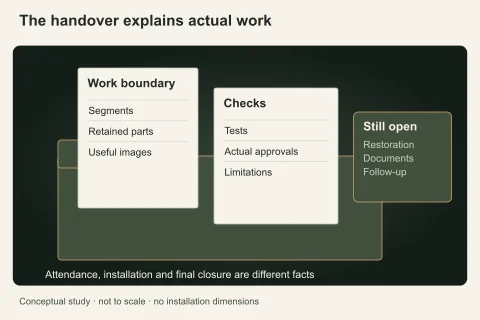
Define the tests, reports, relevant inspection closure and restoration needed at handover. Record remaining tasks and the responsible party. Manufacturer terms and workmanship terms should be distinguishable, with an actual contact for a problem. A marketing warranty phrase does not explain every exclusion or administration requirement.
If there is a disagreement, preserve the agreement, correspondence, invoices and technical findings. Use the appropriate consumer or legal process without inventing a remedy. A cause report can support a factual discussion but does not by itself settle every question about contractual rights, payment or responsibility.
Prepare a contract-clarification request
Build a contract-clarification request around the decision you need. Identify the province, work stage and the scope or payment wording you cannot understand. Remove unrelated financial and personal details before sharing an excerpt. Select the province and community yourself, identify the property type and say whether you are the owner, tenant or authorized manager. An approximate location is sufficient for early planning; private access instructions and personal documents belong in a later secure conversation with the person who actually needs them. Distinguish a preferred date from confirmed attendance, and tell the reviewer which facts are still unknown.
PlumbersNearMe.ca is a Canadian reference and human-reviewed request service. It is not a plumbing contractor, ranked directory or emergency dispatcher, and a submitted request does not reserve a provider. A person reviews the information and replies without a promised response time. Ask for clarification questions and official starting points; the review is not legal advice or a binding interpretation of your agreement. Keep the written agreement, approvals and completion evidence with the property record. Use the request form after any immediate safety need has been addressed; do not wait for this site to respond to an active hazard.
Questions people ask
Is there one Canadian cooling-off period?
No universal period should be assumed for every plumbing agreement. Province and contract circumstances matter. Consult the relevant official consumer authority and appropriate advice before relying on a rule from another location or arrangement.
Does a fixed price cover hidden conditions?
Read the assumptions and change terms. A fixed amount may cover a defined task while leaving concealed conditions outside it. Require clear authorization for additional work rather than treating the headline amount as unlimited coverage.
Should verbal promises appear in the agreement?
Material scope and financial commitments should be recorded in the accepted version. A later reader needs to understand the arrangement without reconstructing the conversation. Ask for exclusions and agreed clarifications to be incorporated before acceptance.
Can this site resolve a contract dispute?
No. It can organize planning questions and official starting points. Preserve records and use the relevant consumer, legal or other authorized process. A human-reviewed request does not determine rights or issue a binding remedy.
Sources and further reading
- Home renovations ↗ · Office of Consumer Affairs, Government of Canada. Checked 2026-10-02.
- Your rights when starting home renovations or repairs ↗ · Government of Ontario. Checked 2026-10-02.
- Hiring a contractor ↗ · Government of Alberta. Checked 2026-10-02.
Confirm the current requirements with the responsible authority for the actual address and work. This reference does not replace site assessment or an official decision.